
Sep 29, 2026Buying Guides
Cake Boards vs. Cake Drums: Which One Does Your Cake Need?
Cake board or cake drum? Compare thickness, strength, sizes, MOQ and cost to pick the right base for every cake - with a clear rule for light, heavy and tiered cakes.
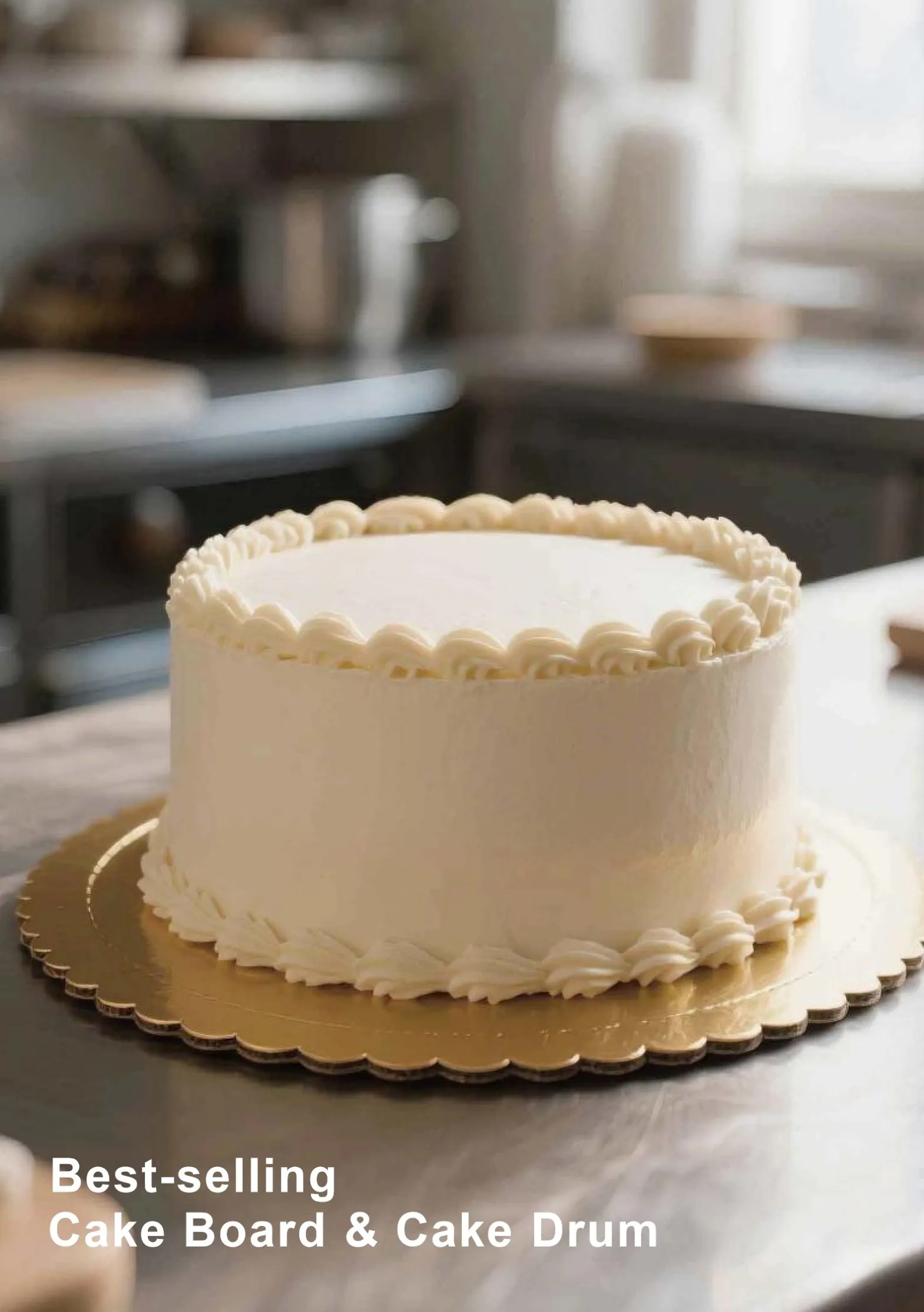
Cake board or cake drum? It is one of the most common questions bakeries ask when ordering bases, and the confusion is understandable - both are flat bases that sit under a cake, both come in the same silver, gold, white and black finishes, and both are priced per piece. But they are not interchangeable. The difference comes down to thickness, strength and what sits on top, and choosing the wrong one means either a bent base under a heavy cake or wasted money under a light one. This guide breaks down both products and gives you a clear rule for every cake you sell.
The 10-Second Answer
Light single-layer cakes of 8 inch and under need only a cake board (2-3 mm). Heavy, tiered, fruit and 10 inch+ celebration cakes need a cake drum (12-15 mm).
When in doubt, size up to the drum: a base that is too thin bends and can crack the cake below it, while a base that is thicker than needed costs only slightly more and looks more premium on the counter.
What Is a Cake Board?
A cake board is the thin, flat base placed directly under a cake. Most cake boards are 1-5 mm thick and sized 4-24 inch, cut from three main materials:
- Corrugated boards (2-3 mm) - light, budget-friendly and the everyday choice for counter cakes and box cakes
- Hard boards (1-5 mm) - denser and stiffer, for cakes that need a firmer carry
- MDF / masonite boards (2-6 mm) - the premium smooth option that stays perfectly flat under display cakes
Think of a cake board as a carrying base: the cake is dressed on it, boxed on it and handed over on it - but the board itself is usually hidden by a ribbon, a wrap or the cake box.
What Is a Cake Drum?
A cake drum is the heavyweight version of the base: 12-15 mm thick (up to 3 cm for extra-thick drums), built from corrugated paper with a rigid core, and finished with a wrapped foil edge all the way around. Drums run 4-30 inch.
Think of a cake drum as a display base: it carries heavy cakes without flexing, its wrapped edge looks finished with no extra decoration, and a 3 cm drum is even thick enough to double as a low, straight-sided cake stand.
Cake Board vs. Cake Drum at a Glance
Aspect | Cake Board | Cake Drum |
|---|---|---|
Thickness | 1-5 mm | 12-15 mm (up to 3 cm) |
Strength | Light to medium cakes | Heavy, tiered and fruit cakes |
Edge | Flat cut edge | Wrapped foil edge |
Presentation | Usually hidden or wrapped | Display-ready as-is |
Common sizes | 4-24 inch | 4-30 inch |
Typical MOQ | ~3,000 pcs (thin) / ~1,000 pcs (thick) | ~1,000 pcs (500 pcs for 3 cm) |
Best for | Everyday bakery cakes | Weddings, tiers, heavy cakes |
The single biggest difference: a drum is roughly four times thicker than a board, and that thickness is what keeps a heavy cake flat, stable and crack-free in transit.
Which One Does Your Cake Need?
- Single-layer 6-8 inch birthday cake - a 2-3 mm corrugated board is enough; the cake is light and boxed right after decorating
- Two-layer 8-10 inch buttercream cake - step up to a 4-5 mm double-thick board for a stiff, no-flex carry
- Fruit cake or dense mud cake (any size) - always a 12 mm+ drum; weight, not diameter, is what bends a base
- Tiered cakes - a drum under the bottom tier, sized 2 inches larger than that tier (14 inch+ drums are standard here)
- Wedding and display cakes - a drum with a silver or gold wrapped edge, or a custom printed edge with your logo
- Cakesicles, dessert slices and pastries - thin 1-2 mm hard boards; anything thicker is wasted spend
Can You Use Both Together?
Yes - and professional bakeries often do. The classic setup is dress the cake on a thin board, then set that board on a drum for presentation and transport. You get the easy handling of a light board during decorating and the finished look and load capacity of the drum at delivery, all for a few cents more per order.
Cost and Wholesale Considerations
- Minimums - thin boards typically run ~3,000 pcs per size and color, drums ~1,000 pcs, and 3 cm extra-thick drums from ~500 pcs; plan your assortment around the MOQ you can actually turn
- Storage - thin boards stack flat and compact; drums are 4-6x bulkier per piece, so order drum sizes you genuinely sell weekly
- Freight - drums are light but volumetric; quote freight by volume before committing to mixed pallets
- Assortment rule of thumb - stock boards for the daily menu, drums for the celebration calendar (weddings, holidays, big birthdays)
Frequently Asked Questions
Can I use a drum under a small cake?
Yes. A drum under a 6 inch cake is over-spec but harmless - it simply costs more per order than the cake requires.
Can a cake board hold a tiered cake?
No. Even a double-thick 5 mm board can flex under a stacked tier. Tiered cakes go on drums, full stop.
Why do drums have wrapped edges?
The wrapped foil edge covers the corrugated core, protects the edge from dents in transit, and gives a finished metallic rim that needs no ribbon or wrapping.
Do I still need a cake board if I have a drum?
Usually not - the cake can be dressed directly on the drum. Keep a thin board underneath only when you want a smaller carry surface for decorating.
Are boards and drums greaseproof?
The foil and film finishes used on both provide a grease barrier for direct cake contact; uncoated kraft boards are best paired with a doily or food-safe liner.
Conclusion
The rule to remember: weight and tiers decide the base, not habit. Light daily cakes ride on 2-3 mm boards, heavy and stacked cakes ride on 12-15 mm drums, and the two work even better as a team. Match the base to the cake, and both your cake and your margin stay intact. Rongxing Shide manufactures cake boards and drums from 4 to 30 inch - corrugated, hard board, MDF, wrapped-edge and 3 cm extra-thick drums - with custom colors, printed edges and mixed-size programs. Contact us for samples and a quotation matched to your best-selling cakes.
